

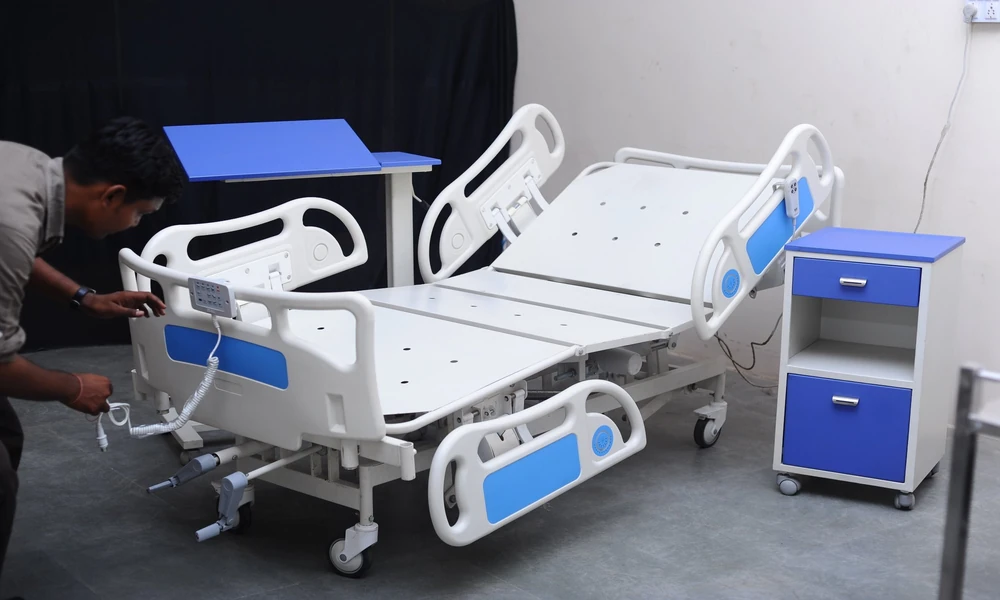
Caring for a patient at home or in a clinical setting requires equipment that supports both the patient’s comfort and the caregiver’s ability to provide effective care. An electric medical bed is one of the most important investments in any care environment, allowing height, backrest, and leg position to be adjusted with minimal effort, reducing the physical strain on caregivers and improving the patient’s ability to rest, eat, and recover in a supported position. Understanding the types of electric hospital beds available, what to look for, and how to buy hospital bed online in India helps families and healthcare facilities make an informed decision.
What Is an Electric Medical Bed?
An electric medical bed, also referred to as an electric hospital bed, is a care bed in which one or more adjustable sections are powered by electric motors rather than manual hand cranks. The motors are controlled by a handset that the patient or caregiver can operate without physical exertion, allowing smooth, precise adjustment of the bed’s height, backrest angle, leg elevation, and, in more advanced models, the position of individual sections.
Electric adjustment is a significant practical improvement over manual hospital beds for most home care and clinical situations. Caregivers who need to adjust a patient’s position frequently throughout the day , for feeding, physiotherapy, repositioning to prevent pressure sores, or simply to improve comfort , can do so quickly and safely without the mechanical effort that manual adjustment requires. Patients who retain some mobility and cognitive function can also operate the handset independently, improving autonomy and reducing dependence on caregivers for routine position changes.
Types of Electric Hospital Beds Available in India
Semi-electric beds combine electric adjustment for the backrest and leg sections with manual height adjustment via a hand crank. These are among the most widely used configurations for home care in India, offering the key clinical positioning functions electrically at a lower price point than fully electric models.
Fully electric beds provide electric control over all three primary adjustments , backrest, leg elevation, and overall bed height , through a single handset. The height adjustment is particularly valuable in clinical settings and for caregivers managing patients with limited mobility, as it allows the bed to be raised to a working height for nursing tasks and lowered to facilitate patient transfers.
ICU and high-dependency beds are fully electric and include additional features such as Trendelenburg and reverse Trendelenburg positioning, cardiac chair configuration, CPR release for rapid flat positioning, and integrated side rails with locking mechanisms. These are designed for acute care settings rather than home use.
Bariatric electric beds are designed for patients with higher body weights, with reinforced frames, wider sleeping surfaces, and higher weight capacities than standard models.
Key Features to Evaluate When Buying a Hospital Bed
Weight capacity is the first specification to confirm. Standard electric hospital beds in India are typically rated for 150 to 200 kilograms. For patients who exceed this range, a bariatric bed with a higher rated capacity is required. Exceeding the rated weight capacity compromises the structural integrity of the bed and the reliability of the motor mechanisms.
Number of motorised functions determines how much adjustment is possible without manual effort. A two-function electric bed controls backrest and leg position. A three-function bed adds height adjustment. Higher-specification models offer independent control of additional sections. The appropriate specification depends on the patient’s condition, the level of caregiver involvement, and the clinical requirements of the care setting.
Side rail configuration affects patient safety, particularly for patients at risk of falls or those who move in the sleep. Removable, foldable, or split side rails that allow access from the side while maintaining partial protection are the most versatile configuration for home care.
Mattress compatibility should be confirmed before purchase. Most standard electric hospital beds accept foam, spring, or air mattress systems of standard widths. Patients at high risk of pressure ulcers require a specialist pressure-relieving mattress, and the bed frame must be compatible with the mattress type specified by the treating clinician.
Mobility and portability varies by model. Beds with lockable castors allow repositioning within a room and locking in place for stable care. For home environments, the bed’s footprint and the doorway clearances required for delivery and installation should be confirmed before ordering.
Electric Hospital Bed Price in India: What Influences Cost
The electric hospital bed price in India varies considerably by type, brand, specification, and source. Entry-level semi-electric beds for home care typically range from Rs 25,000 to Rs 55,000. Fully electric models with three-function control range from Rs 50,000 to Rs 1.5 lakh depending on the brand and specifications. ICU and specialty beds can cost significantly more.
The factors that most significantly influence price are the number of motorised functions, the quality of the motor and control system, the frame material and finish (powder-coated mild steel versus stainless steel), the weight capacity, the inclusion of accessories such as overbed tables, IV stands, and mattresses, and whether the bed is imported or domestically manufactured.
Buyers should be cautious of very low-priced beds that do not carry clear specifications, warranty documentation, or verifiable after-sales support. A hospital bed is a safety-critical piece of equipment, and the cost of motor failure or structural failure in a care environment can be far higher than the price difference between a reliable and an unreliable product.
How to Buy a Hospital Bed Online in India
The ability to buy hospital bed online has made the process significantly more convenient for families and small healthcare facilities across India. Most major medical equipment suppliers and e-commerce platforms carry a range of electric hospital beds with detailed specifications, multiple photographs, and customer reviews that aid comparison.
When purchasing electric beds online, the key steps are: confirming the full specification against the patient’s clinical needs; verifying the seller’s warranty terms and after-sales service coverage in the relevant city; confirming delivery timelines and whether assembly is included; and checking return or exchange policies in case the bed does not meet expectations on delivery.
For home care purchases, speaking with the patient’s treating physician or a physiotherapist before finalising the bed specification is advisable. The clinical team can advise on the positioning functions required, the appropriate mattress type, and any specific features the patient’s condition necessitates, avoiding the cost of a mismatch between the bed purchased and the care requirements.
Maintaining an Electric Hospital Bed
Electric hospital beds require periodic maintenance to ensure the motor mechanisms, electrical systems, and structural components remain in reliable working order. Caregivers should follow the manufacturer’s guidelines for cleaning the bed frame and side rails using appropriate disinfectants that do not damage the finish or the electrical components. Electrical connections and the handset cable should be inspected regularly for wear or damage.
Motor and electrical faults should be reported to the supplier or manufacturer’s service team rather than investigated independently, as the electrical systems in medical beds are regulated and should only be serviced by qualified technicians. Most reputable suppliers offer annual maintenance contracts that cover periodic inspection and priority response for faults, which is a worthwhile investment for beds in continuous use.


